

Fire Limit State (FLS) Design Approach [Part 1]
Fire Limited State (FLS)
Fire Limited State is one of the design approaches to be considered in PIR application. It considers the reduced performance in adhesive & rebar in emergency of fire.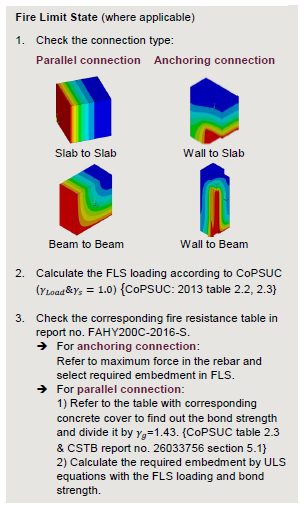
Fire Resistance Rating (FRR)

Three criterions are included in the Fire Resistance Rating (FRR) in Hong Kong. In PIR application, stability is the major criterion to be considered. The main purpose of such rating is to quantify the length of time that the structural element can sustain under fire and such timeframe is crucial for civilians in the building to evacuate in the emergency of fire.
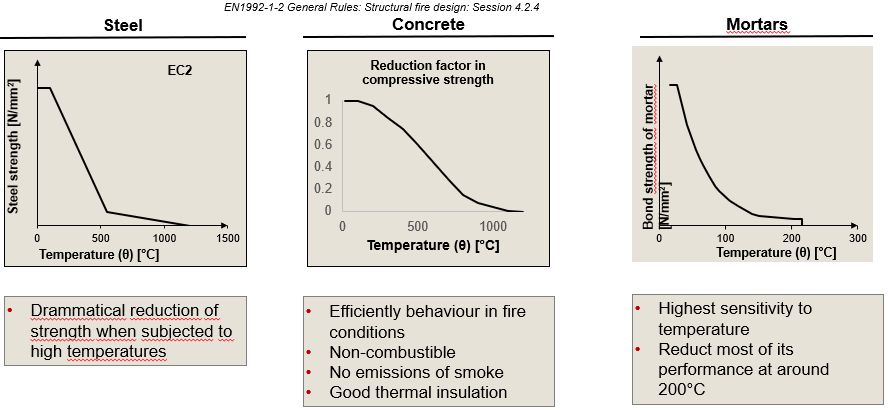
In a PIR connection, there are three major types of material: Steel from rebar, concrete and mortars (adhesives). The strength of materials performs differently at increasing temperature. Mortar has the highest sensitivity to temperature and loses most of its performance at around 200°C, while steel strength reduces dramatically and loses most of its performance at around 1000°C. Concrete is the least sensitive toward temperature out of the three material.
Theoretical background of Heat Transfer Analysis
There are three major ways for heat transfer: conduction, convection and radiation. In PIR application, we consider conduction as the major form of heat transfer from heat source to rebar. The key parameter to control rebar temperature would be the concrete cover, i.e. the distance between rebar and heated concrete surface.
There are mostly four types of connection and we classify them into two categories: Parallel connection and anchorage connection.

The categorization is based on the temperature distribution in rebar due to geometry.
Constant Temperature profile along Anchorage Length in Parallel Case

Parallel connection includes connection types such as Slab-to-Slab and Beam-to-Beam connection. The special feature of parallel connection is that the temperature profile along the rebar is at constant. The reason is because the distance between rebar and heated concrete surface is maintained the same as they are parallel to each other.
Non-constant Temperature Profile along Anchorage Length in Anchorage Case
Anchorage connection includes connection types such as Wall-to-Slab and Wall-to-Beam connection. The special feature of anchorage connection is that the temperature profile along the rebar is not constant. For instance, in the left figure, the red section of the rebar is further away from the heated concrete surface, the heat transfer experienced in this section is expected to be smaller and the temperature will be lower. Hence, a non-constant temperature profile of rebar is formed.
After understanding the temperature profile of different connection, another key parameter to obtain is the relationship between adhesive performance and temperature.
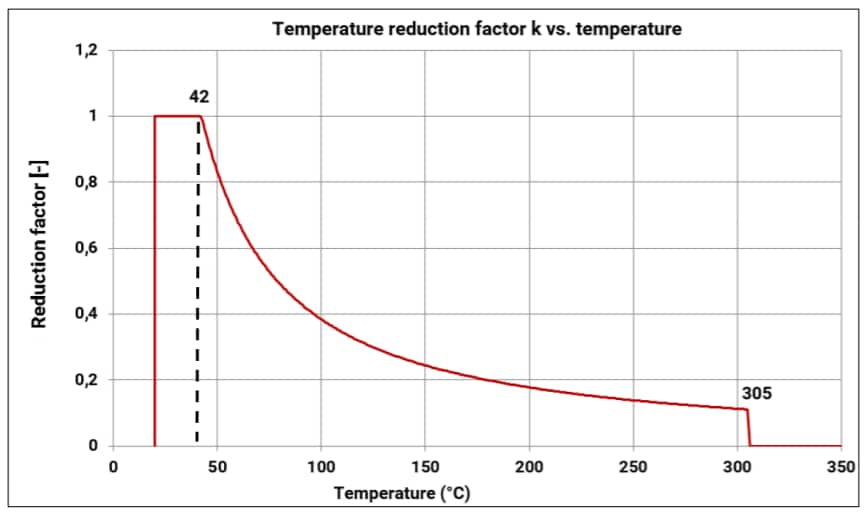
Testings are carried out to plot the reduction factor of adhesive at different temperature.
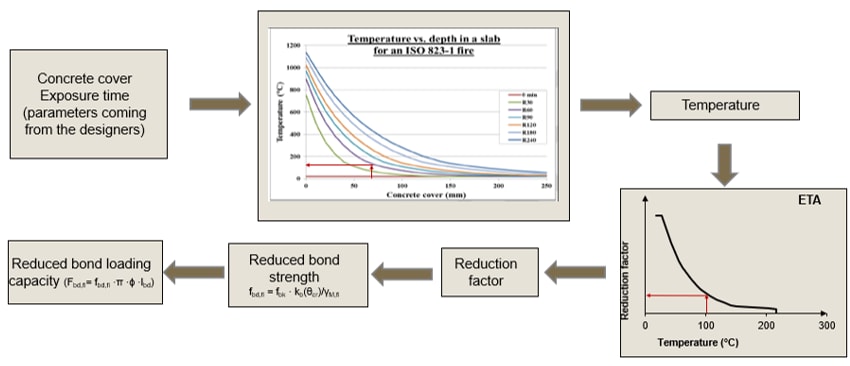
With these two pieces of important information, we can obtain the temperature profile of rebar in different configuration and the corresponding performance change in the adhesive. Finally, we can calculate the rebar performance under the Fire Limit State condition.
Local Fire Assessment
In order to have a more locally adopted technical data to facilitate engineers’ calculation, HILTI conducted a research studies for our product HIT-HY 200 under Hong Kong Fire Resistance Condition.
Local assessment needed to cater HK Codes’ Deviation

Realizing the differences in the equation and thermo-mechanical properties between Eurocodes & Hong Kong Codes, the assumption and result of the local assessment are based on local codes to have a more appropriate result for local engineers
Methodology of the Assessment
The study itself is a combination of experimental data on the performance of adhesive under increased temperature and finite element modeling of temperature profiles in concrete. Finite element modeling simulates the temperature distribution of concrete in a 3-dimensional manner to understand the temperature experienced by rebar at different depth and location.
[To be continued]