
Must-know applications for MEP consultants and Architects
The role of firestopping
Firestopping is basically very simple and follows exactly the logic of a fire. Firestop systems have to be tested according to strict test standards. This safeguards the functionality of a system and gives a clear indication to the designer and installer that the respective firestop product is a reliable solution passive fire protection measure.
As there are many interdependencies and many different criteria to be considered (like wall and floor materials, different penetrants like cables, burnable pipes, steel pipes or insulation materials) the fire testing as such is a huge challenge for manufacturers. Therefore, designers and construction responsible are asked to take this topic very serious and only rely to established and recognized manufacturers with long-term market experience, dedicated resources for testing and development and professional accredited quality and production control systems. The risk of a fire shall never be underestimated.
Firestop applications: cable and pipe penetration, joints
Cable penetrations: this area is a very typical problem area. Configurations range from single cables, cable bundles to heavily loaded cable trays or ladders. Cables also come in burnable plastic conduits. Cables consist of different plastic materials (insulation), rubber and copper. Components which burn, melt, transfer heat and develop toxic smoke. Heavy cable penetration systems also endanger the mechanical stability of a fire rated through-penetration application in case of a fire.

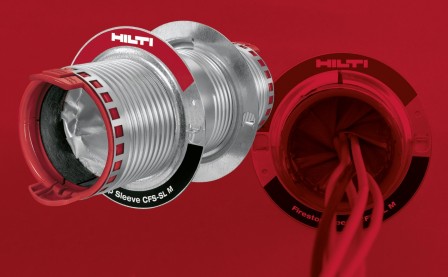
Pipe penetrations: this application area is very diverse and implicates many practical problems. One can mainly separate this application into two main topics: plastic (burnable pipes) and metal (non-burnable pipes). Burnable pipes melt and burn away and leave a hole through which heat, fire and smoke can travel. Special firestop devices like firestop collars with intumescent inlay material which expands when confronted with fire closes the opening and reinstates the fire integrity. Metal pipes transfer significant heat from one compartment to the next and increases risks of ignition of combustible material. Most pipes are insulated respectively have to be insulated to avoid fire risks. Different insulation materials also define respective firestop solutions and have to be considered for proper firestop functionality. Pipe movement (seismic, vibration or temperature movement) should also be considered choosing specially tested pre-engineered products.

Construction joints: joints between walls, floors, or wall to floor represent the third application area. The main problem is cost of installation as specific joints are quite complex of fire seal. A typical example is the top-of-wall joint between a drywall construction and a floor. Movement, acoustics and ease of installation are challenges. Hilti for example provides easy to install pre-designed top track seal system CFS-TTS which offers many inherent properties and which can be easily specified and designed. Another crucial joint type is the perimeter or curtain wall joint. Recent fires of high-rise buildings and skyscrapers showed the dramatic consequences of fire, heat and smoke transfer from one floor to the next floor on the edge of slab. Special spray solutions cover many of the existing risks of this type of joint applications, like the Hilti Firestop Joint Spray CFS-SP WB. Special tests prove reliability and functionality in curtain wall joint applications.


Hilti, with own world-class research and development is committed to supply easy-to-use firestop solutions, providing cutting-edge and fully integrated and tested systems. At the end of the day, together with a unique professional technical support in many countries, this helps specifiers and installers to correctly select the right system for the right application and also to correctly specify compliant and tested solutions.