
Breakthrough Coating Technology - Zinc Magnesium (ZM)
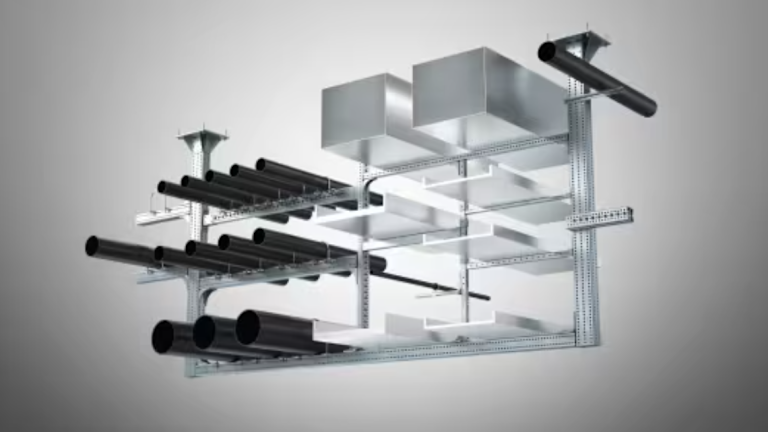
Innovative MT profiles technology for multiple trade installations
What is Zinc-Magnesium (ZM)
Hilti MT System, a modularized supporting system for multiple trade installations, has been designed with the most innovative corrosion protection for long-term use in indoor and outdoor environments with low to moderate pollution. With the latest Zinc Magnesium, it offers a cost-optimized, robust, and durable solution which requires less rework and is environmentally conscious.
What is Zinc-Magnesium (ZM)
Zinc Magnesium (ZM) galvanisation is a coating applied to raw steel, prior to production of the finished products. The Zinc-Magnesium alloy used contains magnesium, and additionally aluminum (is also referred to as ZnAlMg). The microscopic view can be seen in the picture as below:

Zinc Magnesium (ZM) technology is utilized, conforming to ASTM A1046 and EN 10346 and thus the next evolution in outdoor exposure resistance. ZM coating results in superior corrosion protection in comparison to standard zinc coatings (e.g. hot dipped galvanised) for equal coating thicknesses. This marries perfectly with the HDG solution of our components.
Generally a coating of 24 µm is applied to obtain similar (although tests show significantly better) performance than standard HDG coating.

Four key Official standards provide a solid foundation for using ZM coatings
EN 10346: 2015
“Continuously hot-dip coated steel flat products”
ASTM A1046 / A1046M-17 (since February 2017)
“Standard Specification for Steel Sheet, Zinc-Aluminium-Magnesium Alloy-Coated by the Hot-Dip Process”
DIN 55634-1:2018-3
Corrosion protection of supporting thin-walled building components made of steel”
JIS G3323 2012
“Hot-Dip Zinc-Aluminium-Magnesium alloy coated steel strip and sheet”
Limitation on Hot-Dip Galvanization (HDG)
Inconsistent corrosion protection of product
- Due to the shape of strut equal coating thickness and quality of zinc is not easy, leading to potential quality and robustness variances
- Resultant zinc coating may not be consistent between the inside vs. outside surface of a channel
Difficulties during installation
- Coating around holes can be difficult, resulting in tolerances being relatively large or uneven coating thickness
- Serrations and other surface geometries are not HDG friendly, limiting function use or having an inconsistent zinc layer
Sensitivity during installation and use
- Safety of installer may be impaired due to sharp edges / zinc splinters, and raised projections may be left after molten zinc droplets solidify
- Damage and scratching during installation (e.g. some installation habits with standard BS strut create impact on the HDG coating)
- Cut edges need post treatment with zinc spray
Aesthetic appearance not optimal
- Damage during use may occur due to the sensitivity of the HDG coating to abrasion and impact
- HDG provides an uneven appearance
Typical as-produced HDG strut:

Significant reduction in the production steps for ZM vs. HDG

Benefits of using ZM
Less rework: The self-healing characteristics of ZM mean that cut edges or damages require no post treatment (such as cold zinc spray).
Higher robustness: Due to the greater surface hardness of ZM, damages to the coating during installation and operation are much less likely.
Environmental friendliness: The ZM coating process emits less CO2 during production and simplifies logistics.
Cost optimization: ZM is applied to the raw material as a pre-coating, eliminating the cost of post-forming processes and the associated transportation.
Higher corrosion resistance: ZM offers at least two times the corrosion protection of HDG with the same thickness.

Excellent Self-healing performance
After cutting or damage, corrosion products will “heal” the exposed edge:

Combined effect of barrier protection and self-healing leads to excellent corrosion resistance:

Self-healing effect seen in practice in polluted traffic environment:

Self-healing effect seen after 9 months in marine environment (Dunkerque (France) Marine Environment, 25 µm ZM coating):

5 year testing in C5M environment by French corrosion institute (FCI) (Marine environment (Brest, France) with C5M classification, 2 metres from sea):

Corrosion products provide a superior barrier mechanism, out-performing the ZM itself

Contributing to environmental protection through lower energy consumption & durability
Lower consumption of energy à simplified processing methodology, no need for post-coating activities
Lower consumption of resources à preservation of zinc, lower thickness needed for equal corrosion resistance
Lower CO2 contribution compared to stainless steel and aluminum
Contains no hazardous material à conforms to European REACH chemical regulations, and supports green building objectives (e.g. U.S. Green Building Council’s LEED)
Significantly reduced zinc runoff in soils
100% recyclable with no loss in quality
Extended product life
Life Cycle Assessment (LCA)* demonstrates cradle-to-gate impact far less than 65 µm zinc HDG coating

* According to ISO 14040;
** According EN 15804, module “product stage” à covering raw material, transportation and manufacturing
Hilti’s expertise – the foundation of our corrosion protection solutions
Hilti is renowned for its innovative and industry leading solutions. Backed by extensive inhouse know-how and testing capabilities, extended to partnerships with independent corrosion expertise and testing establishments, Hilti has been diligently working on the optimisation of corrosion protection of modular support systems for decades. The end result is the continued delivery of an industry leading solution, built on a wealth of tested and verified data.